
How AI Disruption Is Destroying Portfolio Company Value — And What PE & VC Firms Must Do Now
Published by IT Impact Consulting | IT Strategy for Private Equity & Venture Capital Portfolio Companies
_1777884334829-BpwxNyWV-da4ad3f490.webp)
The $13 Billion Lesson Every Executive Can't Afford to Ignore
AI disruption is no longer a future risk. It is a present reality — and the market is already separating organizations that recognize this from those that don't.
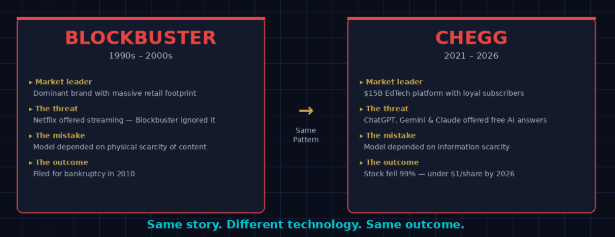
Chegg's collapse is the clearest case study we have right now. But if it sounds familiar, it should — this is the same story as Blockbuster.
Blockbuster had scale, brand loyalty, and a dominant market position. It saw the threat coming and still couldn't adapt in time. The technology shifted faster than the business model could. Chegg is Blockbuster for the AI era.
At its peak in early 2021, Chegg was valued at nearly $15 billion — a dominant EdTech platform with a loyal subscriber base, strong brand equity, and proven unit economics. By April 2026, its stock had fallen below $1. A 99% valuation wipeout in under five years.
What destroyed $13 billion in value wasn't competition. It was irrelevance.
The Three-Stage Collapse Pattern PE Firms Must Recognize
The sequence is worth studying closely.
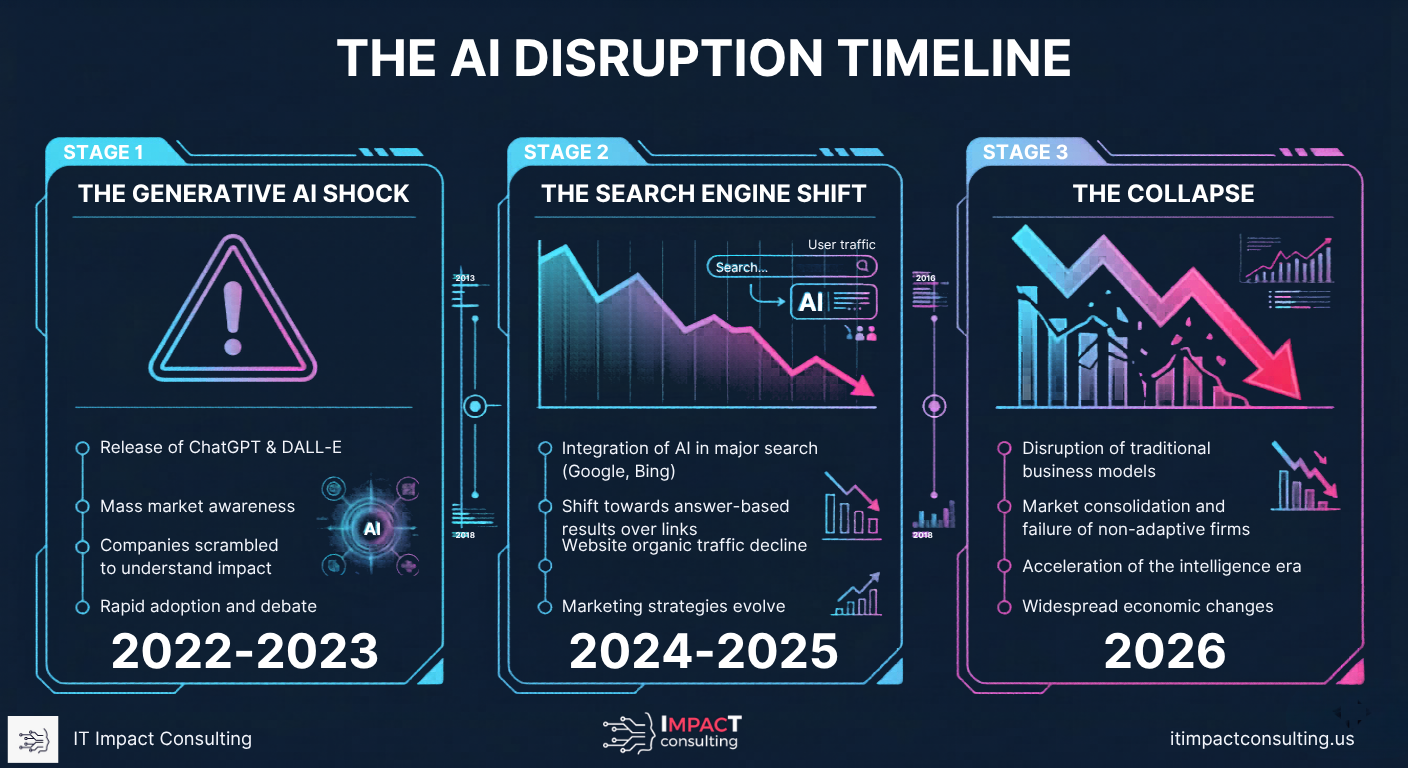
📍 2022–2023 — The Generative AI Shock
Tools like ChatGPT, Google's Gemini, and Anthropic's Claude launched and immediately changed user behavior. Students who once paid for Chegg's subscription discovered they could get comparable — or superior — answers instantly and for free. Chegg reported a 48% single-day stock drop as the implications became clear to the market.
📍 2024–2025 — The Search Engine Shift
AI-native search features eliminated organic traffic at scale. Google's AI Overviews meant users no longer needed to click through to third-party platforms. The traffic engine that had driven Chegg's growth simply stopped working.
📍 2026 — The Collapse
Despite layoffs and cost restructuring, the company could not recover. Its AI pivot came too late — and critically, offered no differentiated value beyond what users could access directly from foundational models.
The failure wasn't operational. It was strategic.
Chegg didn't underperform on execution. It failed to recognize that its business model had a structural dependency on information scarcity — and AI eliminated that scarcity overnight. Blockbuster made the same mistake with physical media. The technology changed. The business model didn't.
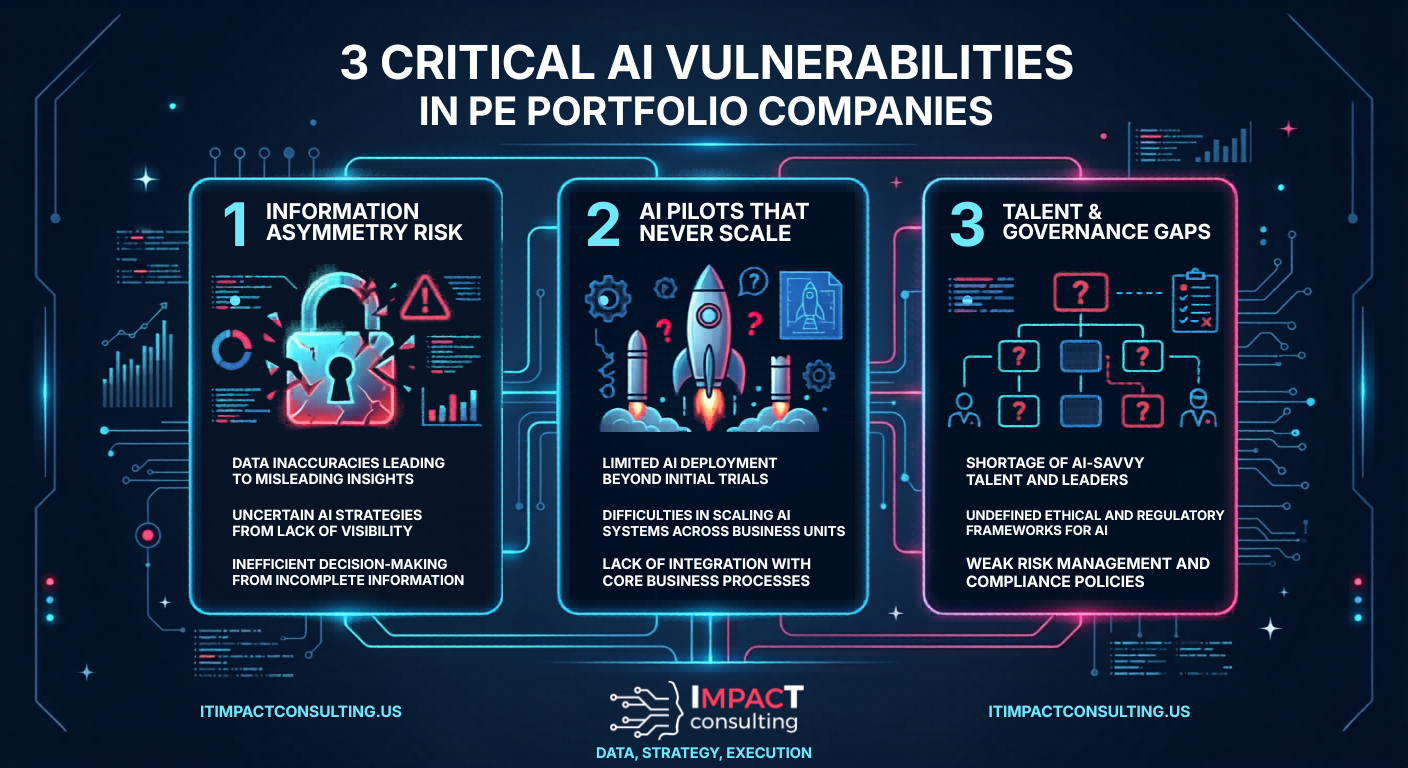
This pattern is repeating across every sector right now. Healthcare systems still building workflows around manual processes. Financial services firms with AI pilots that never scale past proof-of-concept. Consulting practices selling frameworks that AI can now generate in seconds.
Where Your Portfolio Companies Are Most Exposed Right Now
The risk isn't ignorance of AI. It's the gap between awareness and genuine transformation.
The question executives need to be asking isn't "should we adopt AI?" That debate is over. What matters now is whether your portfolio companies have the strategy, architecture, talent, and governance to move from awareness to execution — before the market moves past them.
The Three Questions Every PE Operating Partner Must Ask Today
The real questions are:
- 1
Where does our current business model depend on information asymmetry or friction that AI is eliminating?
- 2
Are our AI initiatives integrated into core operations — or isolated experiments that look good in board decks?
- 3
Do we have the talent, governance, and architecture to move from pilot to scale — and how fast?
The window to act strategically is narrowing. What took Chegg five years to lose, some industries will experience in two. The organizations that will lead are those conducting honest assessments of their AI readiness today — not after a market event forces the conversation. The first step is knowing where you actually stand.
How IT Impact Consulting Helps PE & VC Firms Protect and Grow Portfolio Value
We work with enterprises, governments, and educational institutions globally to navigate AI transformation through readiness assessments, transformation roadmaps, and governance frameworks aligned to global AI standards.
We also deliver AI training programs worldwide — both virtual and in-person — in partnership with leading accreditation networks, equipping workforces at every level with the skills to compete in an AI-native economy.
_1777882368803-D_R2rmOi-2573802fad.webp)
The Window to Act Strategically Is Narrowing
If your organization is ready for that conversation, let's connect. itimpactconsulting.us | Contact@itimpactconsulting.us
Ready to Find Out Where You Stand?
Most PE and VC portfolio companies don't know their AI readiness score until it's too late. IT Impact Consulting's AI Readiness Assessment gives you a clear picture of where your company stands today — and exactly what to do next.
Take the Free AI Readiness AssessmentWritten by: Aamish Mirza. Connect on LinkedIn.